TL;DR
Weeping tile is the perforated pipe buried around your foundation footing, and it carries groundwater off before it can reach your wall. When it fails, it fails quietly: silt, roots, or a crushed section. Here's what you can check on your own place before the fall rain starts.
What is weeping tile, and where is it?
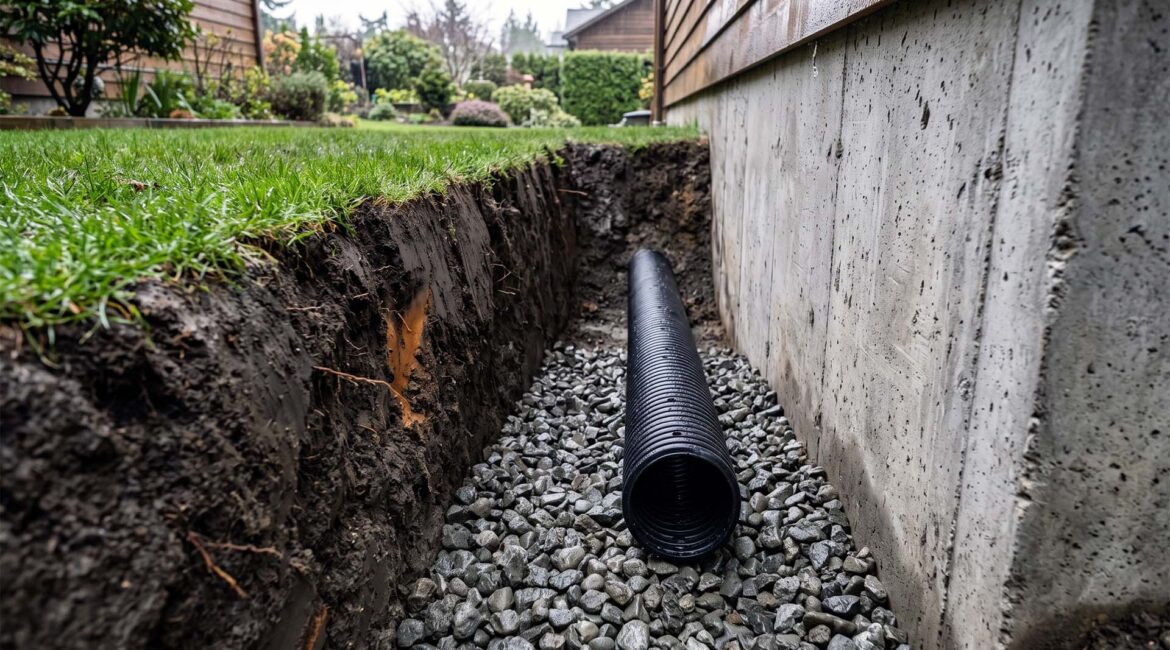
Weeping tile is a perforated pipe that rings the outside of your foundation, sitting at or just below the footing. You've almost certainly got one, and probably never thought about it.
Groundwater seeps in through the holes and drains away downhill, so it never rises against your wall. No pump, no power, no moving parts. You'll also hear it called a perimeter drain.
Modern pipe is bedded in drain rock and wrapped in a filter fabric sock. That fabric is designed to load up and fail first.
The pipe slopes toward a discharge point: a sump pit, a storm connection, or a daylight outlet. Homes on the White Rock hillside usually drain by gravity. Flatter lots near the water table depend on a pump.
That matters, because a drainage problem and a pump problem look identical from inside the house. Same puddle, two different repairs, so work out which you have before you diagnose anything.
Not sure? That's a thirty-second question, and we'll answer it without coming out.
Why does weeping tile fail?
Weeping tile doesn't wear out the way a water heater does. It gets blocked, crushed, or overwhelmed. Three problems, three different fixes.
Silt and fine sediment
Fine soil particles hitch a ride with the groundwater and settle inside the pipe. The filter fabric catches them until it loads up and quits passing water.
Sandy soils move more material, so properties near Crescent Beach silt up faster. Capacity drops season by season until a heavy rain exceeds what's left.
Root intrusion
Roots follow moisture, and a pipe full of water is what they're after. They come in through the perforations, then thicken and trap sediment behind them, the same way they block a buried drain line anywhere else.
Cedar hedges and mature trees close to the house are the usual suspects. The root mass matches whatever you can see above ground.
Crushed or separated pipe
Corrugated plastic gives way under settling soil, renovation equipment, or a patio poured over top of it. Joints work apart as the ground shifts, dumping water exactly where you wanted dry.
So if a patio, driveway or addition has gone in since the house was built, mention it. It narrows things down fast.
Pro tip
Downspouts tied straight into the weeping tile are common in older homes, and a common cause of overload. Rerouting them to their own line takes real load off a system built for groundwater.
What can you check yourself?
You can't inspect buried pipe without digging it up, and you shouldn't have to. What you can do is read the symptoms, which tells a plumber where to start.
Follow your downspouts in the rain
Wait for a decent rain, grab a jacket, and trace each downspout. Note any that vanish into the ground. For the rest, watch whether the water heads away or gathers against the wall.
Water pooling within a metre (three feet) of the wall goes straight down to the footing. That's more load than the pipe was sized for.
Read the ground against the foundation
Soil settles slowly enough that you never notice. A grade that shed water away twenty years ago can end up tilting back toward the house.
Look for a dip, soil piled above the top of the wall, or lawn that stays squelchy for days. Inside, that chalky white crust is efflorescence. It doesn't prove the pipe failed, but it proves the wall is wet too often.
Walk the basement after heavy rain
Timing is the whole diagnostic. Water during or right after rain points at surface drainage or a blocked perimeter system. Water days later points at a high water table or a failed discharge.
Check the joint where the wall meets the slab, and listen to the sump if you have one. Constant running, or none at all, is worth mentioning.
Stay out of any crawlspace with standing water. That's a call, not an inspection.
Walk your house and tick these off
Anything you couldn't tick is worth a conversation. And if a wet basement has you thinking about early warning, a leak sensor at the low point catches the next one.
What needs equipment rather than eyes?
Everything above is you looking. Confirming it means getting inside the pipe.
A camera run through a cleanout shows what's actually in there: a silt line, a root mass, a crushed section, or nothing at all. A locator traces the run and marks its depth, so any digging happens over the failure rather than across your yard.
Not every house has accessible cleanouts. Tell us the age of the house and we can usually guess. If the trouble sits past the foundation, you're into exterior underground pipe work.
When to call us
Call us when you've got symptoms, not when you've got water on the floor. That's the point of walking the house in August, while nothing is urgent.
- Water at the wall-to-slab joint after rain
- A sump that runs constantly, or never
- Ground that stays saturated against the foundation
- A downspout feeding an unknown line
- White crust that keeps coming back
The fix ranges from rerouting a downspout to excavating a run of pipe, and guessing wrong gets expensive fast.
Tell us what you're seeing and we'll tell you what it usually means. No visit needed for that, and no obligation. If it's worth a look, you'll have a free quote before anything gets dug.
Monday to Friday, 8:00 AM to 4:00 PM. Texts are fine, and a photo helps.
The bottom line
Weeping tile moves groundwater away before it can rise against your wall, and it fails quietly. Silt, roots, and crushed pipe stop it, and every one shows above ground first.
So take twenty minutes this week and walk the outside of your house. If something on that checklist won't tick, you've found your starting point.
Once the rain settles in you're diagnosing a live problem instead of a dormant one. Harder, wetter, costlier.
Common questions about weeping tile
Can weeping tile be cleaned instead of replaced?
Sometimes. A silted line with intact pipe can often be flushed through a cleanout. A collapsed section can't, and flushing won't rescue a loaded filter fabric.
Does every house have weeping tile?
No, and that surprises people. Older homes may have nothing, clay tile that failed long ago, or a partial system on one elevation. A camera inspection will settle it.
Is a sump pump a substitute for working weeping tile?
No. The pump only moves water the weeping tile has already delivered to the pit. If the pipe is blocked, that water never reaches the pump.
Still not sure what you're looking at? Describe the symptom and when it happens, and we'll tell you whether it's drainage, the pump, or something else.
Monday to Friday, 8:00 AM to 4:00 PM.