TL;DR
Poly B is the grey plastic water pipe that went into Canadian homes from roughly 1978 through the mid-1990s. You can identify it yourself in about ten minutes.
Check the pipe at your hot water tank, under a sink and at your main shut off valve, then look for PB2110 printed along the side. Finding it is worth knowing. It is not an emergency on its own.
Table of Contents
- What is Poly B pipe?
- Where to look for Poly B in your home
- What the printing on the pipe tells you
- What colour and fittings tell you
- What if the pipe is hidden behind drywall?
- Does finding Poly B mean you have a problem?
- When to call us
- The bottom line
- Common questions
What is Poly B pipe?
Poly B is short for polybutylene, a flexible grey plastic pipe that carries water to your taps. If your house went up between 1978 and the mid-1990s, there’s a decent chance it’s in your walls right now.
Why builders used it
It was cheap, it bent around corners, and a crew could run a whole house in a fraction of the time copper took. For about fifteen years it looked like a great idea.
Why it became a problem
Chlorine in treated water attacks the pipe from the inside. The material turns brittle, tiny cracks form, and the fittings that join the lengths together give out too. The leaks tend to show up without warning, which is the part that stings.
Poly B is no longer an accepted material under the National Plumbing Code of Canada. That’s why it turns up on inspection reports and in listing remarks so often now.
Where to look for Poly B in your home
Grab your phone for the light. No tools needed, and you won’t be touching anything.
Start at the hot water tank
Easiest look in the house. The pipes going into and out of the tank are usually bare for at least 30 to 60 cm (12 to 24″).
Then check under a sink
Open the cabinet under a bathroom or kitchen sink and find the two lines feeding the taps. Look at the pipe itself, not the braided hose at the top.
Finish at the main shut-off valve
Your main shut-off sits where the water enters the house, usually in a crawlspace, garage, mechanical room, or basement. There’s almost always bare pipe there, even in a finished home.
If you’ve got an unfinished basement or crawlspace, that’s your best view by far. Run your eye along the joists. Poly B was often pulled in long lengths with very few joints, so one sightline tells you a lot.
Pro tip: photograph every pipe you find, with the printing in focus. If you end up calling a plumber, those photos answer half the questions before anyone drives out.
What the printing on the pipe tells you
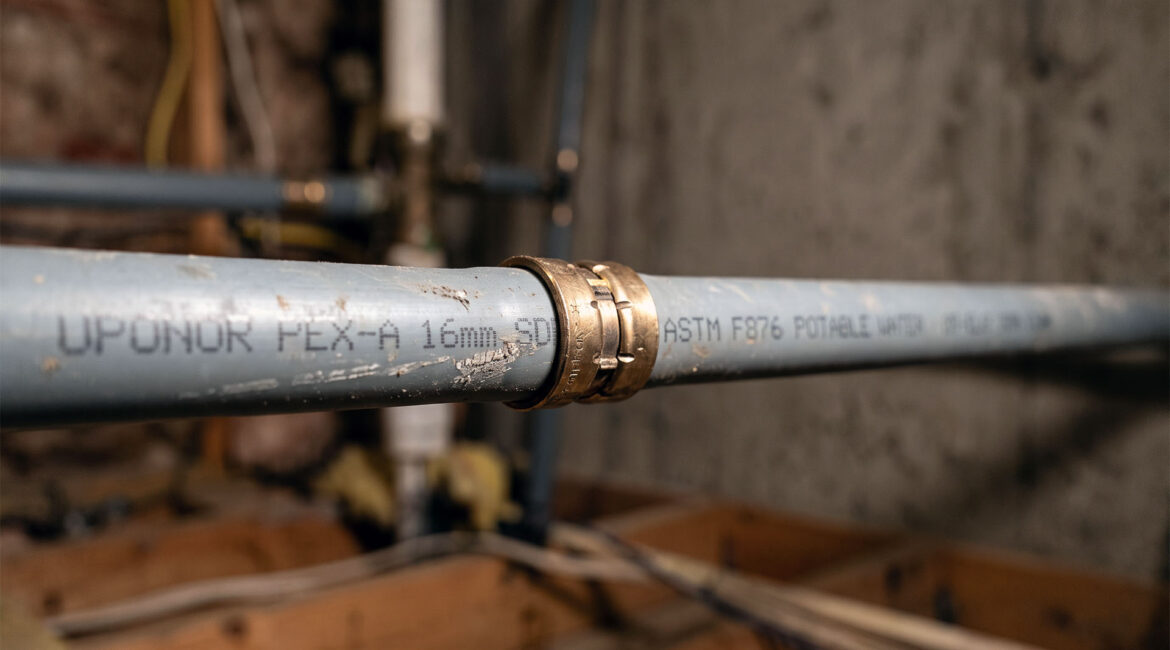
Every length of Poly B has text printed along its side. That print line is the closest thing to a definitive answer you’ll get.
The code that confirms it
Look for PB2110. That’s the material designation for polybutylene, and if you see it, you’ve got Poly B. Some pipe carries the Canadian standard number instead, written as CSA-B137.8 or CAN/CSA-B137.8.
Either one confirms it. The print repeats at intervals, so scan a metre (about three feet) of pipe rather than staring at one spot.
What else is in the print line
Alongside the code you’ll usually find a maker name, a size, a pressure rating and often a date. The date is the bonus. It tells you roughly when the plumbing went in.
When the print has faded
Print wears off, especially near a hot water tank where the heat gets to it. Hold your light at a low angle across the surface rather than straight on. Worn lettering catches side light far better.
Still nothing? Missing print doesn’t rule Poly B out. Grey, flexible and crimped at the joints is enough to warrant a second opinion.
What colour and fittings tell you
Colour gets talked about more than it deserves. Useful, but it won’t settle the question by itself.
Colour is a hint, not proof
Poly B is usually grey, and blue and black versions were used outdoors and on water service lines. The catch is that CPVC and some PVC are grey too. The difference you can feel: Poly B flexes under hand pressure, and the rigid plastics don’t.
The fittings are the real giveaway
Early Poly B installs used grey plastic fittings squeezed on with metal crimp rings. Later ones used copper fittings with the same rings. Either way, you get a metal band clamped around the pipe at every joint. That looks nothing like the smooth soldered joints on a copper system.
Telling Poly B from copper and PEX
Copper is rigid, and you won’t bend it by hand. PEX, the modern replacement, flexes like Poly B and uses crimp rings too, so it’s the one that causes confusion. Two things separate them: PEX is usually white, red, or blue, and its print says PEX rather than PB.
Pro tip: the crimp ring is the fastest tell in a dark crawlspace. Rigid metal with soldered joints is copper. Flexible pipe with a metal band at every joint is Poly B or PEX, and the print line settles which.
What if the pipe is hidden behind drywall?
Most of your plumbing is buried in walls, so let’s be honest about what a ten-minute look can actually give you.
What a visual check can and cannot tell you
It tells you what feeds the fixtures you can see, not what’s in the walls. The rest usually matches, though, because houses get plumbed in one go with one material.
Two other places to look
Dig out the home inspection report from when you bought. It’ll normally name the supply piping outright. Then consider the street. Whole blocks in South Surrey and Langley went up at once with the same plumbing package, so a build date inside that window is a real signal.
Watch out for partial repipes
Some homes had a section swapped after a leak, so you might find PEX under one sink and Poly B under another. Check two or three spots before you decide you’ve got your answer.
Does finding Poly B mean you have a problem?
The short answer
No. It means you know what you have, which beats not knowing. Plenty of Poly B systems around here are still in service and holding fine.
What to watch for now
What changes is your attention. Once you know it’s there, keep an eye out for:
- Damp spots on ceilings below bathrooms
- Staining at the base of a wall
- A dripping sound with every tap closed
- A jump in water use you can’t explain
Those are worth acting on quickly no matter what your pipes are made of.
The replacement question comes later
Whether to replace it is a separate decision. That one turns on the age of the system, the fitting type, your water pressure, and the pipe’s condition. Identification comes first.
Pro tip: photograph the fittings at your hot water tank once a year. Comparing this year to last year catches slow weeping at a joint long before it reaches drywall.
When to call us
Identifying pipe is safe homeowner work. You’re looking, not touching. Past that, it’s licensed-trade territory.
Signs that need a plumber
- You find moisture, mineral crust or corrosion at any fitting
- A length of pipe looks bulged, stained or stressed
- You want the whole system assessed rather than the parts in plain view
- You’re buying or selling and need the piping documented properly
- Anything past the main shut-off valve needs opening, cutting, or replacing
Not sure what you are looking at?
Send us the photos. Reading the print off a clear picture takes about a minute, and free estimates are offered on all our services.
Call or text us at (604) 897-4989, and we’ll tell you what you’re looking at.
The bottom line
Ten minutes with a phone light will tell you what your water lines are made of. Grey pipe, crimp rings at the joints, PB2110 in the print: that’s Poly B, and the house was almost certainly plumbed before 2000.
Knowing is the whole point. A system that gets checked once a year is a very different risk. One nobody has looked at since the house went up is another thing entirely. Start at the hot water tank this weekend.
Found grey pipe and want a second opinion before you decide anything? Reach us at (604) 897-4989.
Common questions
Is all Poly B grey?
Not always. Grey is the common one indoors, but blue and black Poly B was used outdoors and on water service lines. Read the print rather than trusting the colour.
Can a plumber identify Poly B from a photo?
Usually, yes. The print repeats along the pipe, so one clear shot of a stretch near the hot water tank is normally enough to call it.
What years was Poly B installed in Canadian homes?
Roughly 1978 through the mid-1990s. The heaviest run came through the suburban building boom of the late 1980s and early 1990s. A house built after 1998 is very unlikely to have it, though a partial repipe can leave you with a mix.
Got your photos and want a plumber to confirm what you found? Call or text us at (604) 897-4989.