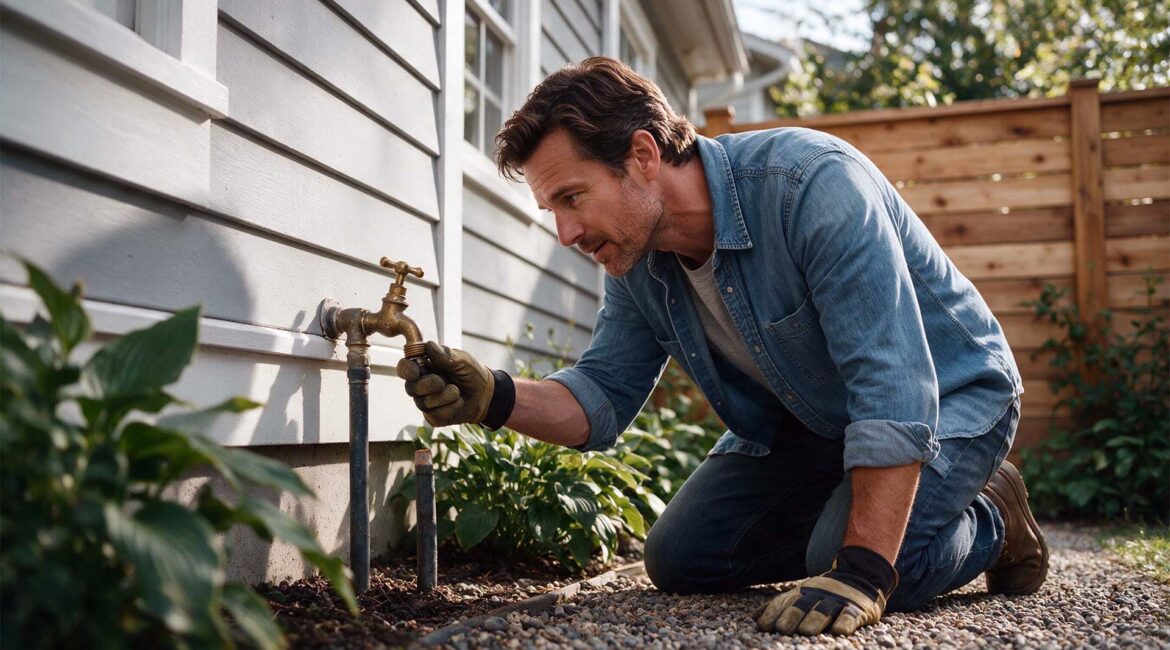
How to replace an outdoor faucet: what the job involves before cutting
TL;DR: Replacing an outdoor faucet is rarely the quick swap it looks like. The faucet is just the visible end of a pipe running through your wall, and what sits behind it decides the whole job. Work out the connection type, the shut-off valve and the state of the old fitting before anyone picks up a wrench.
Why an outdoor faucet is not a swap job
You look at an outdoor faucet and see a fixture. What you are actually looking at is the tail end of a supply line that runs straight through your rim joist or exterior wall. Almost all of the work is on the other side of that wall, out of sight.
The part you can see is the smallest part of the job
Outside, you get a handle, a spout and a threaded outlet. Inside, there is more to deal with:
- A stem running through the wall cavity
- A penetration through the siding and rim joist
- A joint onto copper, PEX or galvanized pipe
The replacement has to suit all of that, not just the bit you can reach.
Getting it wrong is quiet, and then it is expensive
Wrong stem length? It freezes. No slope? It never drains.
Threaded onto a corroded fitting? It weeps inside the wall for months. The drywall tells you about it long after the mistake was made.
Pro tip: Take two photos. One of the faucet from outside, one of the pipe where it comes into the house. Those two pictures answer most of what we would ask you on the phone.
What kind of faucet do you have?
Two types show up on homes around here, and they are not interchangeable. A standard hose bib is short, with the valve seat right at the wall. A frost free faucet has a long stem, which puts the valve seat back inside the warm part of your house.
How to tell them apart in ten seconds
Turn the tap on, then off, and watch what happens.
| Standard hose bib | Frost free faucet | |
|---|---|---|
| When you shut it off | Flow stops instantly | Trickles for a few seconds |
| Where the valve seat sits | Right at the wall, in the cold | Inside the heated wall, out of the cold |
| Body length | Short | Long stem, 15 to 30 cm (6 to 12 in) |
| Freeze risk | High unless drained every fall | Low, if it is drained and sloped |
| Replacement note | Like for like is usually possible | Stem length has to be measured |
Frost free faucets get measured, never guessed
The stem has to reach past the insulated wall cavity and into heated space. Buy one too short and the valve ends up sitting in the cold, which throws away the only reason you bought it.
Every replacement needs backflow protection
Your outdoor faucet should carry a vacuum breaker, either built into the body or screwed on at the hose thread. It stops water sitting in a hose from getting pulled back into your drinking supply. A licensed plumber will confirm what your particular line needs.
What is the faucet connected to?
This is where an hour of work turns into an afternoon. Four connection types are common behind that wall, and exactly one of them is friendly to a homeowner.
| Connection | What it means | Homeowner job? |
|---|---|---|
| Threaded | Unthreads and goes back together with tape or compound | Yes, if the line also isolates |
| Soldered copper | Cutting and torch work inside a wall cavity, next to framing | No, fire risk |
| PEX | Needs the correct crimp or expansion tool | No, tooling |
| Push-fit | Pipe must be cut square and deburred to seal | No, seal reliability |
| Galvanized steel | Threads corrode solid and the pipe cracks under a wrench | No, stop immediately |
Threaded is the one you want to find
If the faucet threads into a female adapter, it often unthreads cleanly. This is the one case where doing it yourself makes sense, and only if the next section also works out in your favour.
Galvanized pipe is a stop sign
Plenty of older homes here still run galvanized steel out to the tap. The threads corrode solid, and the pipe cracks when someone leans on a wrench.
Grey steel instead of copper or plastic? Put the wrench down. A cracked supply line behind the wall is a much bigger day than a new faucet. Our water pipe installation and repair page covers what replacing that section involves.
Pro tip: Slide a fridge magnet along the pipe near the faucet. It grabs galvanized steel and ignores copper. That five-second test changes the plan more often than anything else on this list.
📞 Call or text (604) 897-4989 if the magnet sticks and you would rather not find out the hard way.
Can you shut off the water to that line alone?
This one question decides everything else. If that outdoor line has its own shut-off valve, you can isolate it and drain it on its own. Everyone else in the house carries on as normal.
Look for a small valve on the pipe feeding the tap
It is usually within a metre (about three feet) of where the line leaves the house. Check three places:
- The crawl space, along the joists
- The basement, near the rim joist
- The garage, where the line runs to an exterior wall
Many of these valves have a little drain cap on the side. That cap is what lets you empty the line for winter.
No isolation valve, no small job
Now the work grows to include shutting the main, draining the system, then refilling and bleeding it.
It is also the obvious moment to add a valve, so next winter’s shutdown takes a minute instead of an afternoon. Our shut-off valve installation and repair page covers that. If the main itself is stiff or weeping, our water main installation and repair page is the one you want.
What replacing an outdoor faucet actually involves
The sequence is short to write down and easy to underestimate. Every step has a way of going wrong, and most of them stay hidden until the wall is closed up again.
The sequence in order
- Identify the faucet type and measure the stem length you need
- Isolate the line and drain it fully
- Free the old faucet without twisting the pipe behind it
- Inspect the fitting or pipe end for corrosion and damage
- Fit the new unit with the correct slope so it drains
- Pressure test, then watch the joint from inside while the water runs
The two steps that catch people out
The first is twisting. An old bib can seize hard enough that your wrench turns the pipe inside the wall instead. That is a leak you cannot see, made by the tool you were fixing it with.
The second is slope. A frost free faucet has to tilt down toward the outside. Leave it level and the stem holds water, then splits on the first hard freeze.
When to call us
Some outdoor faucet replacements are fair homeowner work and some are not. Here is the line, in one place.
| What you are looking at | Who should do it |
|---|---|
| Threaded fitting, copper or PEX, working isolation valve | You, and we will happily say so |
| Soldered copper joint | Us. Torch work next to framing |
| Galvanized steel line | Us. The pipe cracks, not the fitting |
| No isolation valve anywhere | Us. The whole house goes off |
| Old faucet will not budge | Us, before something twists |
Between them, those cover most outdoor faucet replacements in older South Surrey homes.
Timing matters too. Late summer is the window you want. The line is dry, the crawl space is dry, and nothing about the weather is rushing the job.
📞 Call or text (604) 897-4989 and talk it through with us. Our hours are Monday to Friday, 8:00 AM to 4:00 PM.
The bottom line
An outdoor faucet replacement is a plumbing job in a hardware store disguise. The fixture is the easy part. The job lives behind the wall, in the connection type and in whether that line can be shut off by itself.
Replacing one because it froze and split? That is only half the work. The other half is making sure the new one can actually drain before next winter arrives. You can see the full range of work we take on across our plumbing services.
📞 Call or text (604) 897-4989 for a free quote on your outdoor faucet.
Common questions
Can I replace an outdoor faucet myself?
Sometimes, yes. A faucet that threads into a fitting, on copper or PEX, with its own shut-off valve, is fair homeowner work. Missing any one of those three? Then no.
Do I need a permit to replace an outdoor faucet?
That depends on your municipality, so check with yours first. Swapping a fixture like for like is treated differently from work that changes the supply line itself.
Why does my new outdoor faucet still drip?
Usually a cross-threaded connection, a washer or cartridge damaged during install, or grit that landed in the seat when the line refilled. A drip that shows up right after a replacement is pointing at the fitting, not the faucet.
Not sure which of these is you? Send us a photo, or 📞 call or text (604) 897-4989 and we will give you a free quote on what it actually needs.