TL;DR: To winterize a hose bib, take the hose off, shut the indoor valve, and open the outdoor tap so the pipe can drain. If yours is frost-free, just take the hose off and check that it drains. Try to get it done in October, before the first overnight frost.
Table of contents
- Why does a hose bib split when it freezes?
- How do you winterize a standard hose bib?
- How do you winterize a frost-free hose bib?
- When does a hose bib become a plumber's job?
- A drained hose bib is the one that survives winter
A frozen hose bib can look just fine all winter. You find out in spring, when you turn on the tap and water sprays inside the wall. A few minutes this October saves you that mess.
A hose bib is just the outdoor tap your garden hose screws onto. Some people call it an outside faucet, a spigot, or a sillcock.
Why does a hose bib split when it freezes?
A hose bib splits when water left inside it freezes and expands. Ice takes up about 9% more room than water, and the pipe has nowhere to stretch. The crack usually opens just inside the wall, out of sight.
Our winters are mild most of the time, so it's easy to leave the hose on well into fall. Then a clear night dips below 0 °C (32 °F), and one hard frost can be all it takes.
Walk past your taps after the first frost. Drips or ice on a drained tap usually mean water is sneaking past the indoor valve.
How do you winterize a standard hose bib?
A standard hose bib takes four quick steps: Take the hose off, shut the indoor valve, drain the line, and pop a cover on. The indoor valve is the important one, since it keeps water out of the part of the pipe that can freeze.
What you need to winterize a hose bib
This is an easy job, and you likely have what you need. Grab these before you start.
- A bucket or an old towel for drips.
- A foam outdoor faucet cover for each tap.
- A flashlight for hunting down the indoor valve.
Step 1: Take the hose off the hose bib
Unscrew the hose, plus anything else on the tap like a splitter or a timer. Leaving the hose on holds water against the tap, so the line can't drain. Empty the hose and put it away somewhere dry.
Step 2: Shut the indoor valve for the hose bib
Most standard hose bibs have their own indoor valve, and that's how you shut off the outside water. Follow the pipe in from the outside wall. You'll usually find the valve in one of these spots.
- The basement or crawlspace.
- The laundry room or furnace room.
- Behind a small access panel in a wall or ceiling.
If it has a round handle, turn it clockwise until it stops. If it has a lever, turn it a quarter turn so it sits across the pipe.
If you've just moved in, it's worth finding this valve now. It's a lot easier on a quiet fall afternoon than in the middle of a leak.
Step 3: Drain the line through the outdoor tap
Head back outside and open the hose bib all the way. A bit of water will run out, and then it should stop. Leave the tap open all winter so any last drops have room to expand.
Some indoor valves have a small cap on the side. If yours does, open it over your bucket to drain the rest of the line.
If water still runs outside after a minute, the indoor valve is leaking. Get that valve fixed before the cold sets in.
Step 4: Put an outdoor faucet cover on the tap
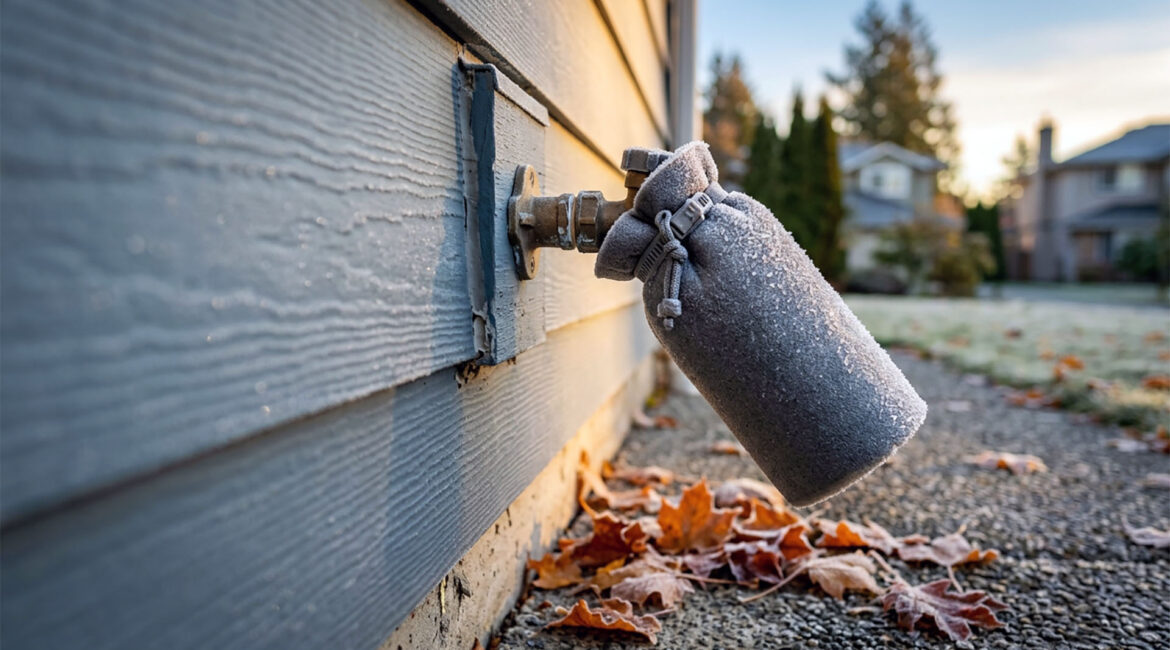
Slip an outdoor faucet cover over the tap to help keep the cold off. It does the most good on a pipe you've already drained. If you're near Crescent Beach, a snug cover also keeps sand out of the fitting.
If a tap drips or leaks around the handle, fix it before winter. Our guide to fixing an outdoor faucet shows you how.
Tag the valve while you're down there. Hang a label on it and snap a photo of where it is. Then anyone at home can find it fast if a pipe ever splits.
How do you winterize a frost-free hose bib?
A frost-free hose bib just needs the hose off and a quick check that it drains. Its shut-off sits at the far end of a long stem, tucked inside the warm part of the wall. When you close the tap, the water in that stem runs out instead of sitting where it can freeze.
To tell which kind you have, look at the pipe inside, right behind the tap. A frost-free hose bib has a long body reaching into the house, while a standard one stops at the outside wall.
Why a frost-free hose bib still needs the hose off
A hose left on traps water in the stem, and that water has nowhere to go. It freezes inside the wall, cracks the stem, and stays hidden until spring. That's why frost-free hose bib makers tell you to take the hose off for winter.
Usually the first sign is a wet wall or ceiling the first time you turn the tap on in spring. By then you're dealing with a pipe repair, and maybe some drywall too.
How to check that a frost-free hose bib drains properly
Run the tap for a second, shut it off, and watch the spout. A short trickle is what you want to see, because it means the stem is emptying. The tap should also tilt slightly down toward the yard so water runs out.
If nothing trickles out, or the tap tilts back toward the house, have it checked before winter. The frost-free design only works when the water can get out.
Put it on the calendar. Pick a dry weekend in early October and set a reminder on your phone. It's a much nicer job when it's mild out and your hands aren't freezing.
When does a hose bib become a plumber's job?
A hose bib becomes a plumber's job when a valve leaks, the pipe is damaged, or the fix means opening a wall. You can drain and cover your taps yourself, but anything past the indoor valve needs a licensed plumber. Give us a call if you notice any of these.
- The indoor valve still lets water through after you close it.
- Your standard hose bib has no indoor valve, and you'd like one added.
- The tap drips, sprays around the handle, or has a crack in it.
- You spot water stains on a wall or ceiling near the pipe.
- You'd like to switch to a frost-free hose bib, which means cutting into the water line.
If a hose bib has already frozen, shut the indoor valve and leave the outdoor tap open. As it thaws, check inside for water near the pipe. If you find any, have it looked at before you turn the water back on.
Our licensed Red Seal plumbers fix shut-off valves and water pipes, like the lines to your outdoor taps. 📞 Call or text us at (604) 897-4989, Monday to Friday, 8:00 AM to 4:00 PM, for a free quote. If you text, a photo of the tap is the quickest way to show us what's going on.
A drained hose bib is the one that survives winter
A hose bib gets through winter just fine when the water's out before the first hard frost. On a standard tap, take the hose off, shut the valve inside, drain the line, and add a cover. For a frost-free tap, take the hose off and check that it drains.
If any outdoor tap drips, leaks, or won't shut off, get it fixed while the weather's still mild. 📞 Call or text us at (604) 897-4989 for a free quote.