TL;DR: Frozen pipes are prevented in the fall, not fixed in a panic in January. Take the hoses off and drain the hose bibs. Insulate every exposed pipe you can reach. Seal the drafts that blow cold air across crawl space lines. Keep the heat on, open cabinet doors on the coldest nights, and let one faucet trickle when it gets truly cold. And find your main shut-off valve now, while nothing is wrong.
South Surrey winters are mild most of the time. That is exactly the problem. Our pipes run through crawl spaces, garages, and outside walls that were never built for deep cold. Then an arctic outflow arrives and the temperature drops for three nights straight. Pipes that were fine for five winters freeze in one.
The good news is that prevention is simple, cheap, and mostly a one-time job. Here is the whole routine, in the order we would do it. It pairs with the rain side of fall prep in our atmospheric river prep guide. And if any step sits beyond your comfort level, call or text (604) 897-4989 for a free quote before the cold turns it into a rush job.
What actually happens when a pipe freezes
Water expands as it freezes. Inside a pipe, that expansion has nowhere to go. Ice builds up, pressure builds behind it, and the pipe wall gives way. The split often happens away from the ice itself, which is why a burst pipe can surprise you.
The leak usually shows up at the thaw, not during the freeze. Ice melts, water reaches the split, and now you have a flood on your hands. That timing is why prevention matters so much. By the time you see water, the damage was done hours earlier.
Our companion post on how cold it has to be for your pipes to freeze works through the number behind that pressure, and what decides it at your address.
The pipes that freeze first
Not every pipe in your house is at equal risk. The vulnerable ones share a pattern: they sit outside your heated space, or right up against it.
- Pipes in crawl spaces and unheated basements
- Lines running along outside walls, especially north-facing ones
- Pipes in the garage, including lines to a laundry sink
- Outdoor faucets and hose bibs, and the short lines feeding them
- Lines to additions, sunrooms, and suites that were built on later
If a pipe froze in a past winter, put it at the top of your list. It will freeze again in the same conditions.
Step one: deal with hoses and hose bibs
This is the single most common freeze call we see, and it costs nothing to prevent.
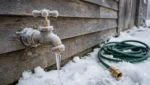
Disconnect every garden hose before the first frost. A hose left attached holds water in the bib and the short pipe behind it. That water freezes, expands, and splits the pipe inside the wall. You often find out in spring, the first time you turn the tap on.
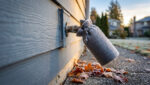
If your hose bib has an indoor shut-off valve, close it, then open the outdoor tap to drain what is left. Leave the outdoor tap open for the winter. A frost-free bib still needs the hose off. Frost-free only protects the pipe when nothing is holding water in it.
Pro tip: Once the bib is drained, leave the outdoor tap open all winter. Leftover water then has room to expand instead of a sealed pipe to split.
Step two: insulate the exposed runs
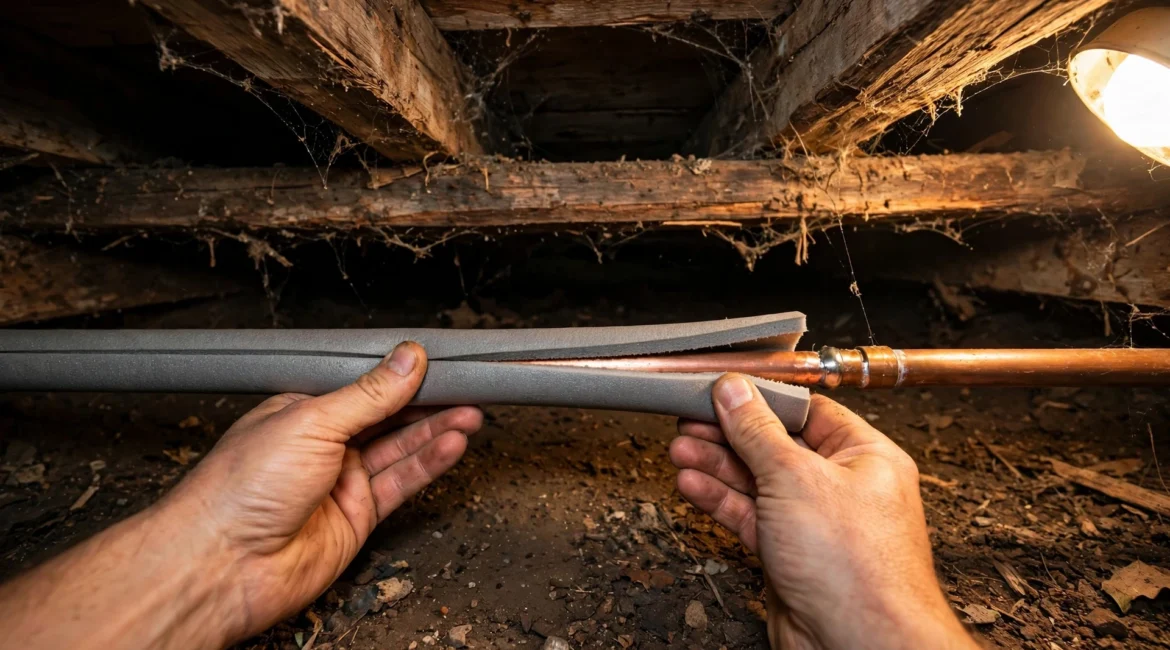
Foam pipe sleeves are the workhorse here. They are pre-slit tubes that snap over the pipe, and a hardware store sells them for a few dollars a length. Size them to your pipe, push them on, and tape the seams and joints.
Start with the crawl space and garage runs you found on your risk list. Cover elbows and fittings too, with mitred pieces or pre-formed covers. A straight run wrapped perfectly does little good if every elbow is bare.
While you are in the crawl space, check any older insulation for gaps, sagging, or sections that fell off years ago. Insulation only works where it actually touches the pipe.
Pro tip: Tape every seam and joint as you go. A sleeve that gaps at the seam lets cold air sit right against the pipe and quietly undoes the job.
Step three: seal the drafts
Insulation slows heat loss. It cannot beat a steady stream of cold air. Walk your crawl space and basement on a windy day and feel for drafts near pipes. The usual culprits are foundation vents, gaps where pipes pass through walls, and cracks around the sill plate.
Seal gaps around pipe penetrations with caulk or foam sealant. If your foundation vents have covers or closeable louvers, set them for winter once the rainy season is underway. Reopen them in spring, so moisture does not build up.
Step four: let your heating system help
Pipes inside your walls share your home’s heat. The simplest protection on a cold night is to not let the house get cold.
- Keep the thermostat at a steady setting during a cold snap, even overnight
- If you travel in winter, leave the heat on. Turning it off to save money risks the most expensive flood of your life
- Open the cabinet doors under kitchen and bathroom sinks on outside walls, so warm room air reaches the pipes
- Leave interior doors open in rooms that sit over unheated spaces
None of this needs to be dramatic. A house kept at a normal, steady temperature protects most interior plumbing on its own.
Step five: the coldest-night trickle
When a real cold snap settles in, let one faucet drip slowly overnight. Pick the faucet farthest from where water enters the house, or one fed by an outside-wall line.
Moving water is much harder to freeze than still water. A slow trickle, about the width of a pencil lead, keeps water moving through the vulnerable run. It costs a little water for a few nights. A burst pipe costs a great deal more.
Step six: find your main shut-off now
Every prevention plan needs a backup, and this is yours. Find your main water shut-off valve and make sure it turns. Look where the water line enters the house, near the front of the crawl space or basement, or by the water heater.
Test it once. Valves that sit untouched for a decade can seize, and a cold snap is the wrong time to learn yours has. Show everyone in the house where it is. If a pipe ever does burst, this valve is the difference between a mop and a restoration crew.
If yours will not turn, that is a small job today and a big one mid-burst. Call or text (604) 897-4989 and we will get it moving while the floor is still dry.
If a pipe freezes anyway
No water at one tap, or just a trickle, usually means a frozen line. Start calm:
- Leave the faucet open, so pressure has somewhere to go as things thaw
- Warm the area gently with a space heater, a hair dryer, or towels soaked in warm water
- Never use a torch, a heat gun on high, or any open flame. That is how fires start
- If you find a split, a bulge, or water where it should not be, close the main shut-off and stop there
We have a full guide to thawing a frozen pipe safely, including when to stop and hand it over. The short version: gentle heat, patience, and no flame, ever.
And if a split has already let water loose, shut the main off first, then book the repair through our contact page. Water moving through a wall is past the DIY line.
When it is a plumber’s job
Call us if a pipe has split or burst, if the same line freezes every winter, or if your shut-off valve will not turn. Repeated freezing in the same spot usually means the line needs rerouting or proper insulation in a place you cannot reach. That is a fall fix too, and it is far cheaper done now than after a flood.
For anything on this list that sits beyond your comfort level, reach us through our contact page for a free quote. Or call South Surrey Plumbing at (604) 897-4989. We serve South Surrey, White Rock, Surrey, and Langley, Monday to Friday, 8:00 AM to 4:00 PM.
Quick questions
Is a dripping faucet wasteful?
For a few nights a year, no. A slow trickle uses far less water than most people expect, and a single burst pipe wastes more in an hour than a faucet drips in a whole season. The trickle is cheap insurance while the cold lasts. Turn it off once the snap breaks.
My pipes froze once and nothing burst. Am I fine?
You were lucky, not protected. A pipe can freeze several times before a weak spot finally splits, and each freeze works on the same tired section of pipe. Treat that one freeze as your warning, not your proof. Do the steps above before the next cold snap, starting with the line that froze.
Does insulation alone stop freezing?
It slows freezing down, sometimes by hours, and that is often enough to carry a pipe through a one-night dip below zero. In a three-day cold snap, insulation works best paired with steady house heat and the overnight trickle. Think of it as buying time, not immunity, and give it help on the coldest nights.