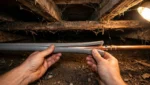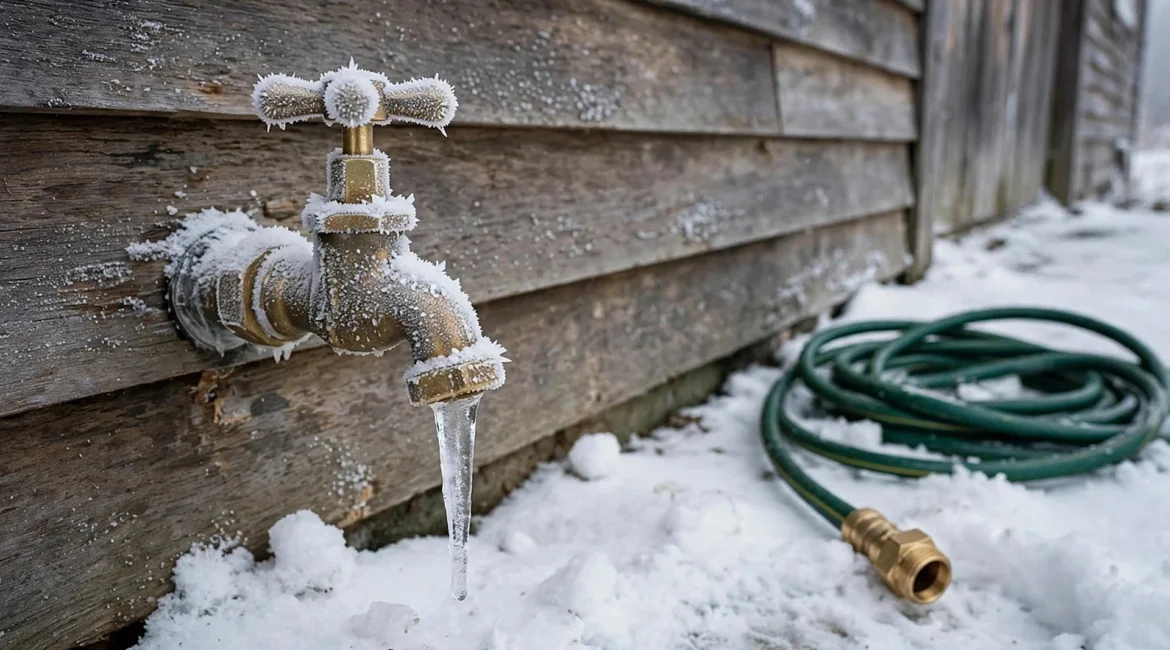
TL;DR: Water freezes at 0 C, but a pipe is not a puddle. Your pipes freeze based on where they run, whether they are insulated, how much cold air moves across them, and how long the cold lasts. A sheltered, insulated line can shrug off a night at -5 C. An exposed crawl space line can freeze on a night that barely dips below zero. The warning signs arrive before the burst. A faucet slows to a trickle. Frost feathers on an exposed pipe. One tap has no water at all.
Every winter, someone in South Surrey asks us the same question. How cold does it have to get before I worry about my pipes?
It is a fair question, and it deserves a straight answer. The straight answer is that there is no single number for a house. There is a number for water, and then there are the five things that decide what happens at your address. Here they are. And if your house already has a freeze on its record, that weak spot is worth fixing in the fall, not testing again in January. Call or text (604) 897-4989 for a free quote while the weather is still mild.
The short answer, and why it misleads
Water freezes at 0 C. That part is simple, and it is where most advice stops.
Your pipes are not sitting out in the open, though. They run inside walls, under floors, and through crawl spaces, all of which are warmer than the air outside. A pipe also holds water that starts at indoor temperature. The cold has to work through the wall, the air gap, and the pipe itself before the water inside reaches 0 C.
So the outdoor thermometer tells you when to start paying attention, not when a pipe freezes. Two houses on the same street, on the same -8 C night, can have completely different outcomes. The difference is below.
What actually decides it
Where the pipe runs
This is the big one. A line in a heated basement may never freeze in a Lower Mainland winter. The same line in a vented crawl space, a garage, or an outside wall lives much closer to the outdoor temperature. Exposure beats the forecast, every time.
Insulation, or the lack of it
Foam sleeves and wall insulation slow the cold down. They buy hours, and hours are usually what a cold snap tests. A bare pipe in moving cold air has no such buffer.
Moving air
Wind does not make a pipe colder than the air around it. What it does is strip warmth away faster. A drafty crawl space pulls heat off a pipe the way wind makes a cold day feel worse on your skin. Sealed and still air protects. Moving air exposes.
How long the cold lasts
A one-hour dip to -3 C at dawn rarely freezes anything. Three nights at -4 C, with days that never climb above zero, freeze plenty. Duration is the factor most people underestimate. Pipes freeze on the third night, not the first.
Still water or moving water
Water sitting motionless in a pipe overnight freezes far sooner than water that moves now and then. That is why the tap nobody uses, in the room nobody heats, is the classic freeze. It is also why a slow overnight trickle works as protection.
Put together, the trade rule of thumb is this. Brief dips just below zero are low risk for most houses. Risk climbs sharply once temperatures sit around -6 C and colder, sooner for exposed lines, later for sheltered ones. Treat -6 C as a warning bell, not a guarantee in either direction.
Pro tip: Judge a cold snap by how long it lasts, not just by its lowest number. One cold night is a dip. Three nights with days that never climb above zero is the pattern that freezes pipes here.
Not all pipes freeze at the same speed
Size matters. A slim line feeding one bathroom tap holds very little water, and a small volume gives up its heat quickly. A larger main line holds more water and buys more time. This is why the first freeze in a house is so often a single bathroom or a hose bib line, not the main.
Material plays a smaller part. Copper tends to split when the water inside it freezes and expands. Modern plastic lines have a bit of give, and sometimes survive a freeze that would have split copper. Sometimes is doing heavy lifting in that sentence, though. No household pipe is freeze-proof, and plastic fittings and joints can still fail.
If those plastic lines are the older grey Poly B, they carry an aging story on top of the freeze risk. Our guide to that grey pipe, and whether it might be Poly B, covers what to watch for.
Why mild-winter homes get caught
Here is the local catch. Homes in South Surrey, White Rock, and Langley were built for a mild coastal climate. Plumbing often runs through crawl spaces and outside walls with modest insulation, because for most winters that is enough.
Then an arctic outflow parks over the coast for three or four days. Daytime highs stay below zero, which almost never happens here. Houses built for -2 C nights are suddenly living in -10 C weather. The pipes that were fine for a decade freeze all at once. Cold snaps here do not need to be record-breaking. They just need to last.
The fix for the worst runs is usually insulation in a spot you cannot reach, or a short reroute away from the outside wall. That is a planned fall job. Book it through our contact page for a free quote, on your schedule instead of the weather’s.
The warning signs
A pipe rarely goes from fine to burst without saying something first. Watch for these during a cold snap:
- A faucet slows to a trickle, or stops. Ice is narrowing the line, or has closed it. This is the earliest and clearest sign
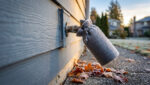
- Frost on an exposed pipe. If you can see frost feathering on a crawl space or garage line, that pipe is at the edge
- Only one tap has no water. A single dead faucet usually means one frozen run, not a supply problem
- Odd smells from a drain. A frozen drain or vent line can push sewer smells back into the room. It is a softer sign, but worth noting beside the others
- Strange sounds. Gurgling or banging as water tries to move past ice
Pro tip: During a cold snap, run each tap once a day, even the ones nobody uses. A faucet that slowed since yesterday is a line closing in, telling you while there is still time to act.
And the sign that it is too late for warnings: water stains, dripping you can hear inside a wall, or a sudden drop in pressure everywhere. That is a burst, and it calls for the main shut-off first and a call or text to (604) 897-4989 second, because water inside a wall spreads quietly and does not wait for a convenient moment.
What to do the night a cold snap is forecast
You do not need the whole winter routine in one evening. These four moves cover most of the risk:
- Open the cabinet doors under sinks on outside walls
- Let the farthest faucet, or one on an outside-wall line, trickle slowly overnight
- Keep the thermostat steady. Do not let the house cool down overnight
- Know where your main shut-off is, in case the morning brings a surprise
The full prevention routine, hoses, hose bibs, insulation, and drafts, lives in our companion post on keeping your pipes from freezing this winter. Do that one in the fall and this list gets much shorter.
If you wake up to no water
One frozen tap is a warning, not a disaster, if you handle it gently. Open the faucet so pressure can escape as things thaw. Warm the area with a space heater or a hair dryer, working patiently. Never reach for a torch or any open flame.
Pro tip: Work the heat from the faucet end back toward the frozen section, so melting water always has an open path out instead of building pressure against the ice.
If you cannot find the frozen section, if a pipe has split, or if water appears where it should not, close the main shut-off. Then call us. Our guide to thawing a frozen pipe safely walks through the careful version, step by step. And for a free quote on any of it, call South Surrey Plumbing at (604) 897-4989, or reach us through our contact page. We serve South Surrey, White Rock, Surrey, and Langley, Monday to Friday, 8:00 AM to 4:00 PM.
Quick questions
Does wind chill count for pipes?
Not the way it counts for skin. Wind cannot cool a pipe below the air temperature. It just gets the pipe to air temperature faster, and holds it there once it arrives. A windy -4 C night in a drafty crawl space is harder on pipes than a still -4 C night, even though the thermometer reads exactly the same for both.
It hit -3 C last winter and nothing froze. Am I safe?
You learned your house can handle a brief -3 C, and that is genuinely useful. You did not learn what happens on the third straight night below zero, with a north wind working on the crawl space vents the whole time. Short dips and long snaps are different tests, and most houses here meet the second one unprepared.