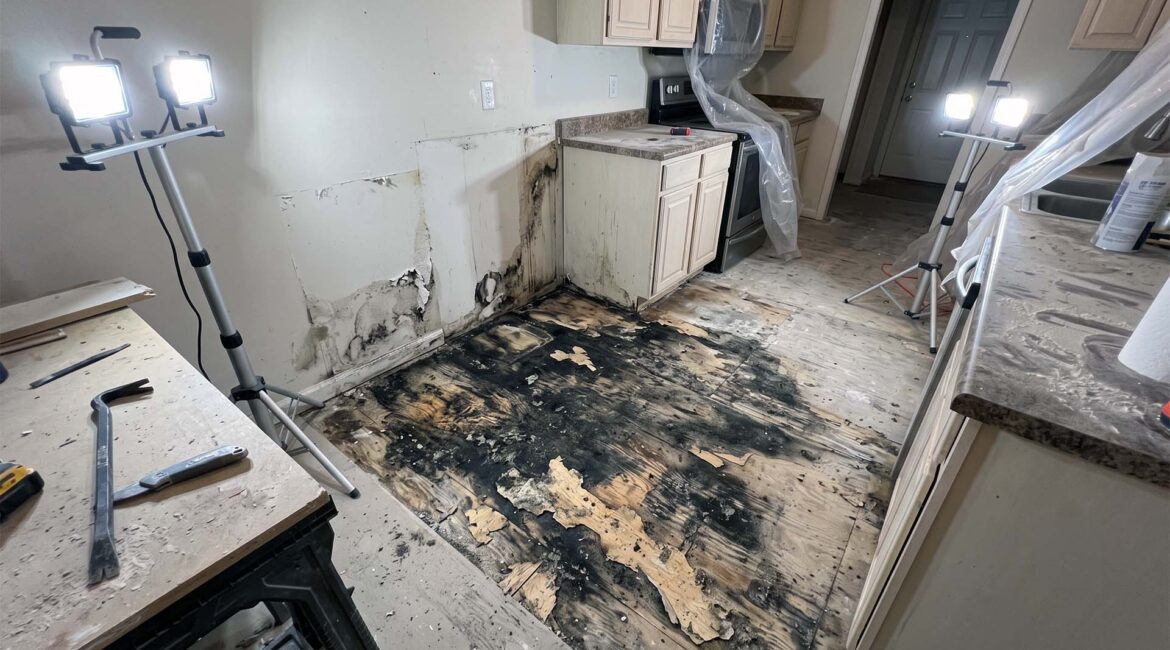
Fridge water line leak: it’s been running for months
TL;DR
Fridge water lines can weep for months before anyone spots it. The fridge is parked right on top of the only connection you’d ever see. Pull the unit out, check the line, the valve, and the floor at the wall. If it’s fed by a saddle valve, that valve needs replacing, not tightening.
Table of contents
- Why nobody catches a fridge leak early
- What are the signs of a leak behind your fridge?
- How do you check the water line behind your fridge?
- Why saddle valves cause most fridge line leaks
- Is that water actually a plumbing leak?
- When to call us
- The bottom line
- Common questions
Why nobody catches a fridge leak early
Because the fridge is sitting on it. The line, the valve, and the wall behind them take up the one square of your kitchen you never look at. Water can run back there for months before it turns up anywhere you’d see it.
The fridge hides the only connection worth watching
If your fridge makes ice or pours water, it’s plumbed. A thin line runs from a valve, usually under the sink or in the basement below, over to the back of the unit. There are at least two threaded joints on that run, and both of them sit behind the appliance.
Nobody moves a fridge on a schedule. It goes in on delivery day and stays put until something goes wrong.
A slow drip soaks in rather than pooling
A big leak floods and gets your attention. A slow one just soaks into the underlay, tracks along the subfloor, and dries off fast enough that you never see standing water.
That’s why the damage shows up in the flooring rather than as a puddle. The board closest to the wall starts to lift.
What are the signs of a leak behind your fridge?
You’ll smell it or see it in the floor long before you see water. Cupped or lifting flooring beside the fridge is one sign. A musty edge in the kitchen air is another.
What you can spot without moving anything
- Flooring that cups, lifts, or feels soft within a metre (about 3 ft) of the fridge
- Dark staining or bubbling paint on the baseboard next to it
- A musty smell that gets stronger when the fridge kicks on
- An ice maker that’s slowed right down, or is making small hollow cubes
That last one is worth its own look, because a struggling ice maker is often the first symptom of a supply problem. Our ice maker installation and repair page walks through what else it can mean.
What only turns up once the fridge is out
- Damp, matted dust across the back of the kick plate
- Green or white crust on a fitting, which is mineral build-up from a long slow weep
- Rust on the coils or the compressor housing at the base
- A tide line on the drywall behind the unit
Take a phone photo of the wall behind your fridge the day it gets delivered. Two years on, that photo is the only way you’ll know whether the stain is new.
How do you check the water line behind your fridge?
Give it twenty minutes. Move the unit, look at three specific joints, then read the floor and the baseboard. What happens next comes down to which joint is wet.
Moving the fridge without wrecking the floor
Empty the door shelves first. Weight up high is what tips a fridge when you pull it. Walk it out slowly, corner by corner. Keep some slack in the water line so you’re never dragging on the fitting at the back.
If the line is short and tight, stop there. Popping a fitting loose while you’re shifting the unit turns a quick check into a flood.
Checking all three connection points
- Where the line meets the valve at the supply end
- Where it meets the fridge, usually a compression fitting down at the base
- Any joint, filter housing, or splice along the run
Wipe a dry paper towel around each joint and look at the towel. A joint that feels dry to your finger will still mark paper. Do it twice, an hour apart, so a slow weep has time to show.
Reading the floor and the baseboard
Push your thumb into the flooring right at the wall. If it’s soft, spongy, or cupped, water has been sitting long enough to reach the subfloor. That’s past a fitting problem.
Photograph everything before you push the fridge back. If a claim comes later, photos taken before anything moved are worth having.
Found a soft floor? That one is worth a phone call before you put the fridge back. 📞 (604) 897-4989
Heading away for a week? Shut the fridge supply valve before you go. A line that only weeps under normal use can let go completely with nobody home, and it’ll run the whole trip. If you travel often, a smart water leak detector at the fridge is the cheap version of this problem.
Why saddle valves cause most fridge line leaks
A saddle valve is a small clamp valve that grips a copper pipe and pierces it with a needle to make the tap. It was the quick way to plumb a fridge, and it isn’t built to last.
What a saddle valve actually is
The clamp squeezes a rubber washer against the pipe, and the needle punches a hole about the width of a pin. None of that is a permanent joint. The washer hardens, the clamp works loose, and the pierced hole corrodes.
They’re easy to spot. Look for a small brass or grey clamp wrapped around a copper line with a little handle on top. Check under the kitchen sink first, then any supply line running below the kitchen.
Why you replace one instead of tightening it
Tightening a weeping saddle valve is the instinct, and it’s the wrong move. Cranking that handle drives the needle deeper, squashes the washer further, and can turn a drip into a spray. Once it starts weeping, it’s done.
The proper fix is a tee and a quarter-turn stop valve, which means cutting into the supply line. That’s licensed work, and your own plumbing isn’t the place to learn it. Here’s what a proper shut-off valve installation involves, or call and we’ll talk you through it. 📞 (604) 897-4989
Is that water actually a plumbing leak?
Not always, and it decides who you should be phoning. Water under a fridge can come from the appliance itself rather than the supply line. Sorting out which one you’ve got takes a few minutes and saves you a wasted call.
A blocked defrost drain is an appliance job
Every fridge sheds water when it defrosts, and that water runs down to a pan above the compressor to evaporate off. If the drain clogs, it backs up and comes out the bottom of the unit instead. That’s a call for an appliance tech, not a plumber.
Telling an appliance problem from a supply leak
- Water at the front or under the door: points to the defrost drain
- Water at the back wall, or tracking toward the valve: points to the supply line
- Ice building up under the crisper drawers: points to the defrost drain
- A wet fitting or mineral crust on brass: points to the supply line
Still not sure? Shut the fridge supply valve and give it a day. If water keeps showing up, it’s the fridge.
When to call us
Call us once the water has got past a fitting you can actually see. That means:
- Flooring that’s cupped, soft, or lifting anywhere near the unit
- A saddle valve of any age, weeping or not
- A supply valve that won’t close, or that weeps at the stem when you turn it
- Any leak you can’t trace back to one of the three connection points
- Staining on the ceiling below your kitchen
We’re here Monday to Friday, 8:00 AM to 5:00 PM. We’ll tell you on the phone whether this is a plumbing call or an appliance call, and if it’s the appliance, we’ll say so.
The bottom line
A fridge line leak is a small failure in the one spot nobody checks, which is exactly why it does so much damage. Twenty minutes behind the unit once a year is the difference between finding it at the fitting and finding it in the floor.
If there’s a saddle valve on that line, treat it as the finding. Swapping it out before it weeps is a straightforward job. Replacing a kitchen floor afterward is not.
Common questions
How long can a fridge water line leak before I notice?
It can run for months. The fridge covers the connection, and a slow weep soaks into the subfloor instead of pooling where you’d catch it.
Can I replace the fridge water line myself?
Swapping the flexible line between the valve and the fridge is within reach for most people. Anything involving the valve itself, or cutting into a supply line, is licensed work.
Do I need a shut-off valve just for the fridge?
Yes, and a proper quarter-turn stop is the one you want. It lets you isolate the fridge without killing water to the whole house.
Not sure which side of the line your leak is on? Send us a photo of the back of the unit and we’ll tell you what we’re looking at. Ask for a free quote, or call us direct. 📞 (604) 897-4989