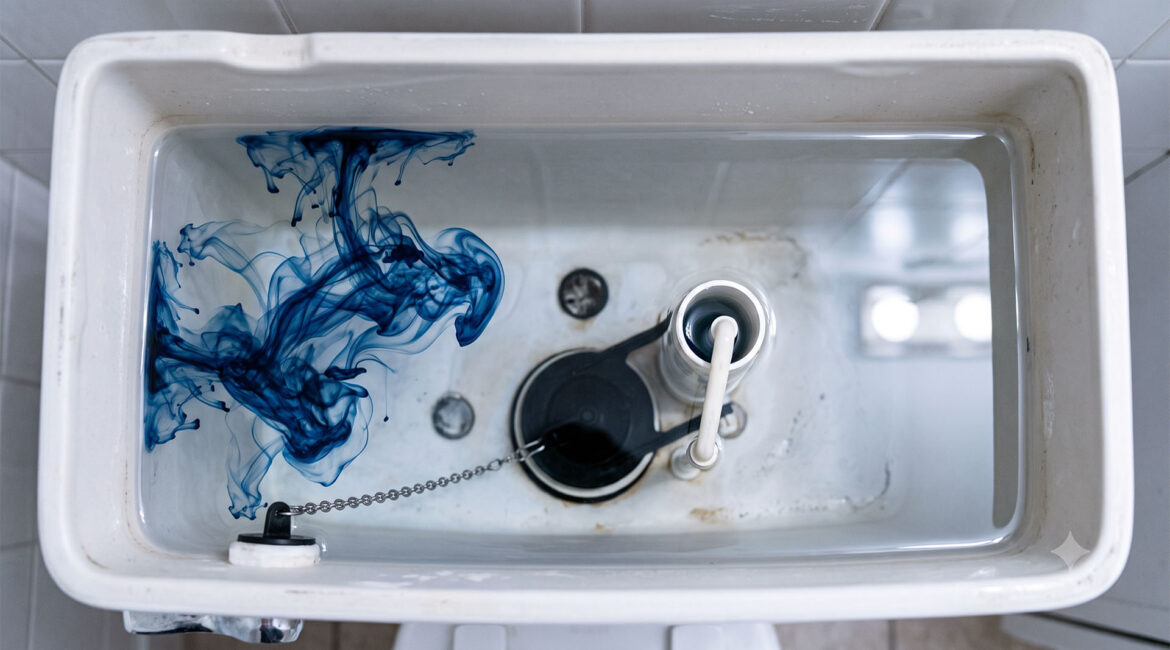
TL;DR: A running toilet is almost always one of three parts: the flapper, the fill valve or the float. A five-minute dye test tells you which, and the fix itself takes under half an hour. A moderate leak quietly sends about 950 L down the drain every day. That’s a lot of drinking water to lose in a summer when you’re not even allowed to water your lawn.
Is your toilet actually running?
Some toilets run loud enough that you can’t ignore them. The expensive ones are the quiet ones, trickling away for months while nobody notices a thing.
The listen test
Shut the bathroom door, turn everything else off, and just stand there for a minute. A healthy toilet makes noise only while the tank refills after a flush, then goes quiet. Any hiss, trickle or refill when nobody’s flushed means water is getting out of the tank.
Ever had to jiggle the handle to make it stop? You’ve already got your answer.
The dye test
Here’s the one that settles it.
- Take the lid off the tank
- Drop in a few drops of food colouring
- Put the lid back and don’t flush
- Wait fifteen or twenty minutes, then look in the bowl
Colour in the bowl means water is sneaking past the flapper. The faster it shows up, the bigger the leak.
What you’re losing while you decide
Toilet leaks scale badly.
- Small leak: about 115 L a day, easy enough to shrug off
- Moderate leak: closer to 950 L a day
- Fill valve stuck wide open: past 13,000 L in twenty-four hours
For scale, a standard flush is about 9 L. So a moderate leak is like flushing your toilet an extra hundred times a day, every day, until somebody catches it.
Pro tip: run the dye test on every toilet in the house, not only the noisy one. Leaks are silent more often than not, and the test costs you twenty minutes and nothing else.
What’s broken in there?
Lift the tank lid and you’re looking at three moving parts. One of them has given up.
The flapper
That’s the rubber seal at the bottom of the tank. It lifts when you flush and drops back to plug the hole. Flappers harden, warp and crack as they age, and in-tank cleaning tablets chew through them fast. This is your culprit most of the time.
The fill valve
The tall assembly on the left, the one that refills the tank. When it goes, it either never shuts off or shuts off too late, sending water down the overflow tube instead of stopping.
The float
Yours is either a ball on an arm or a plastic cup riding up the fill valve shaft. Either way, its only job is telling the fill valve when to quit. Set too high, the tank fills past the overflow tube and the extra runs off non-stop.
The chain and lever
These fail less often, but don’t skip them. A chain caught under the flapper is a genuinely common cause and takes about ten seconds to sort out.
Can’t tell which of the three you’re looking at? Send us a photo of the inside of your tank and we’ll name it for you.
Fix the flapper, the usual culprit
Dye test came back positive? Start here. Give yourself half an hour and you’ll almost certainly be done sooner.
Shut off and drain
- Find the shut off valve behind or below the toilet and turn it clockwise until it stops
- Flush, and hold the handle down to drain the tank as far as it’ll go
- Sponge or towel out whatever’s left in the bottom
Swap the flapper
- Unhook the chain from the lever
- Slide the flapper ears off the pegs on either side of the overflow tube
- Take the old one with you to buy the replacement
Most toilets use a 2″ flapper and newer high-efficiency models often take a 3″. Matching by eye alone is how people end up making a second trip.
Clean the seat before the new one goes on
While the tank is empty, run a finger around the seat the flapper sits against. Grit and mineral build-up there will defeat a brand new flapper just as easily as an old one. Wipe it smooth first.
If it feels pitted or scored rather than just dirty, that’s the flush valve rather than the flapper. Worth getting it looked at before you buy a second flapper that won’t seal either.
Set the chain
The new flapper wants roughly 6 to 13 mm of slack in the chain. Too tight and it never fully seals. Too loose and the chain slips underneath it. Turn the water back on, let the tank fill, and flush a few times to make sure it seats every single time.
Pro tip: if you use in-tank cleaning tablets, stop. They shorten flapper life considerably, and you’ll be back under that lid inside a year or two.
Fix the water level
Dye test came back clean but the thing still runs? Then the water isn’t going under the flapper. It’s going over the top.
Read the overflow tube
The overflow tube is that open vertical pipe in the middle of the tank. Water should sit roughly 25 mm (1″) below its rim. If it’s level with the rim or above it, water is pouring straight down the tube and the fill valve is running constantly trying to keep up.
Adjust the float
On a cup-style float, pinch the clip on the side and slide the cup down the shaft. On a ball-and-arm, turn the adjustment screw where the arm meets the valve, or gently bend the arm down. Small moves here. Flush, let it refill, check the level against the tube, repeat.
When the fill valve itself has gone
Dropped the float and the tank still overfills? Valve hissing away non-stop? Then the valve is the problem, not the setting. Fill valves are a replaceable part and the swap is within reach for a confident DIYer. It does mean disconnecting the supply line under the tank, so know that going in.
Not keen on that part? Fair enough, and it’s a sensible place to draw the line. A fill valve swap is a short visit for us.
Pro tip: once you’ve got the level right, mark it on the inside of the tank with a pencil. Next time something drifts you’ll know in two seconds whether the water moved or something else did.
Why this matters more this summer
Where the region sits right now
Metro Vancouver has been under Stage 2 restrictions since July 16, with all residential and non-residential lawn watering banned outright. The region opened this year at Stage 2 back on May 1, which had never happened before. It climbed to Stage 3 in June, with the snowpack sitting under 15% of its historical average.
The sting
There’s a particular sting to a toilet quietly losing 950 L a day indoors while you’re not allowed to run a sprinkler on your own grass.
The one fix that keeps paying
Here’s the upside. This is the rare conservation measure that asks nothing of you afterward. A new flapper is twenty minutes of your Saturday, and then it just keeps saving water every day without you thinking about it again.
When to call us
Most running toilets are a homeowner fix, and you should feel fine tackling one. Some aren’t. And a few are quietly telling you about a problem that has nothing to do with the toilet.
Signs it’s past DIY
- The shut off valve won’t turn, or starts weeping once you’ve moved it
- You’ve replaced the flapper and the leak carries on
- Water shows up around the base of the toilet, or on the ceiling below
- The tank refills on its own even with the supply shut off
- Every toilet in the house runs, which usually points at pressure rather than parts
Not sure which one you’ve got?
📞 Call or text us at (604) 897-4989 and we’ll talk it through. Free estimates on all our services.
The bottom line
Run the dye test tonight. Twenty minutes, no tools, and it tells you whether you’ve got a problem before your next water bill does.
If colour turns up in the bowl, the flapper is your first suspect and a new one usually ends the story. If the tank is overfilling instead, drop the float and get the water sitting about 25 mm below the overflow tube rim.
📞 Past your comfort level, or fixed it and it came straight back? Reach us at (604) 897-4989.
Common questions
How long does a toilet flapper last?
Four to five years is typical, less if in-tank cleaning tablets are in play. Warping, hardening, or rubber streaks on your fingers all mean it’s done.
My toilet only runs sometimes. Is that still a problem?
Yes. Intermittent running usually means the flapper is sealing inconsistently, often down to chain slack or a rough valve seat. It wastes less than a constant leak, but it’s the same failure caught earlier.
Can a running toilet really raise my water bill?
A moderate leak runs about 950 L a day. A stuck fill valve can top 13,000 L. Neither one is subtle once a full billing period has gone by.
Is it better to replace the whole toilet?
Rarely. Flappers, fill valves and floats are all serviceable parts. Full replacement earns its keep when the tank or bowl is cracked, or when an old high-volume toilet is worth swapping for an efficient one anyway.
Got it sorted and want the rest of the house checked while you’re at it? Call or text us at (604) 897-4989.