Where perimeter drains fail first, and what to check
TL;DR
Perimeter drains fail in three spots: the downspout connection, the lowest corner of the run, and anywhere sediment has been piling up since spring. Check those three in September, while the ground's still dry and the problem is easy to get at. Waiting for a wet crawlspace means you're figuring it out in the worst possible conditions.
Table of contents
- What a perimeter drain actually does
- Where perimeter drains fail first
- What to check before the rain sets in
- Signs you're past the checking stage
- Where the job stops being yours
- Fix it in September, not in February
What a perimeter drain actually does
Your perimeter drain is a pipe full of small holes, buried along the footing of your house and packed in gravel. Its whole job is to catch groundwater before that water finds your foundation wall.
When it's working, you'll never give it a thought. That's rather the point of it.
Where the water goes
Water seeps in through the holes, runs along a slight slope, and leaves at a discharge point. On most homes around here, that's a municipal storm connection.
On lower lots and older houses, it often runs to a sump pit instead. If that's you, a sump pump is part of the system and it needs a look too.
Why you never think about it until it fails
All of this happens about 1.8 metres (6 feet) underground, and nobody inspects it on a schedule. So the first sign most people get is water showing up inside.
By then you're seeing the last stage of something that started months ago. That gap between cause and symptom is the whole problem.
If water's already turning up somewhere it shouldn't, skip the checks below and give us a call. We'd rather talk it through now than after the drywall's gone.
Where perimeter drains fail first
Failures show up in three places, and they're the same three places nearly every time. Each one is a spot where the system changes direction, changes size, or slows down.
- The downspout connection, which takes the heaviest hit
- The lowest corner of the run, where volume and sediment both end up
- Anywhere solids have settled, usually a joint or a flat spot
The downspout connection
A downspout dumps a lot of roof water into the drain in one short burst. That's the heaviest load the system ever sees, and the joint at the connection wears it every single time.
Plenty of older homes have downspouts tied straight into the perimeter line. That puts far more through the pipe than groundwater ever would on its own.
Have a look at the base of each downspout for any of these:
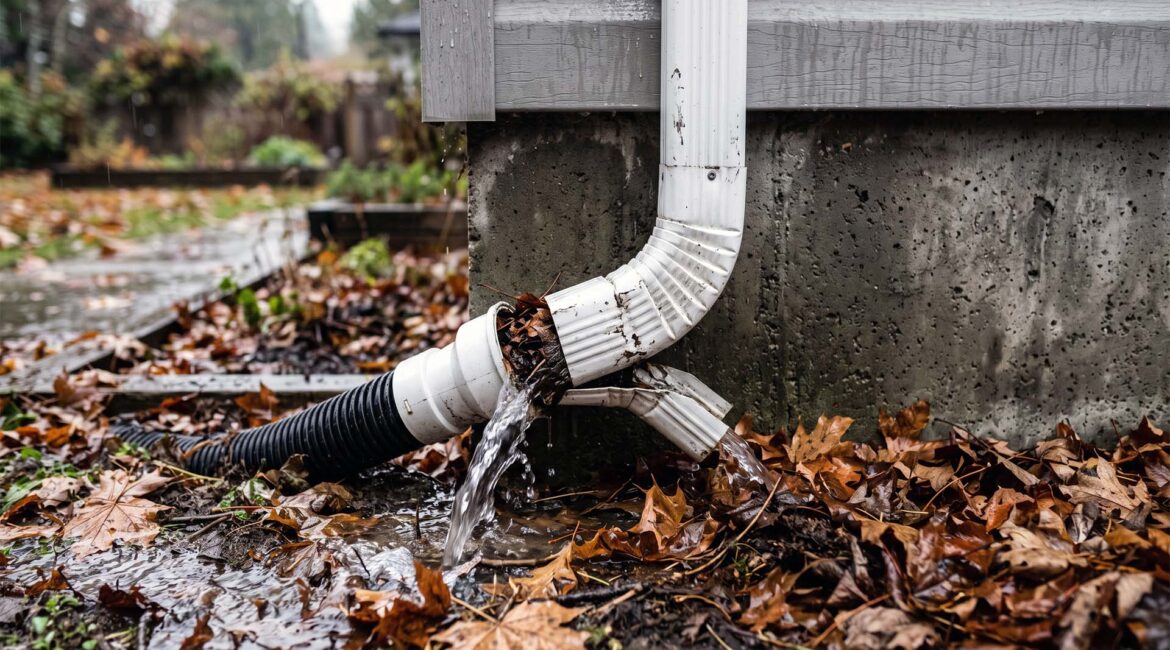
- Water spilling out instead of going in
- A joint that's pulled apart
- A leaf screen packed solid with muck
A downspout dumping against your foundation is the single most common drainage fault we find.
The lowest corner of the run
Water follows the slope, so the low corner gets the most volume and the most sediment. It's also where a partial blockage backs water up instead of passing it along.
If one part of the run is going to hold water, it's this one.
Sediment, roots, and the slow collapse
Fine silt washes in through the holes and settles wherever the flow slows down. Roots follow the damp and work their way in at the joints.
Both are slow. A drain hardly ever fails in a day, it just loses capacity season by season, which is exactly why it's easy to walk past.
What to check before the rain sets in
Three checks, under an hour, and all you need is a garden hose. Do them while the ground is dry, because a dry system gives you a clean baseline to compare against later.
- Run every downspout and watch the base
- Open a cleanout and look for standing water
- Check the crawlspace within a day of the first heavy rain
Start at the downspouts
Walk the house and see where each downspout ends up. It should discharge well clear of the foundation, or into a connection that's intact and clear.
Run water down each one and watch what happens at the bottom. If it pools, backs up, or surfaces somewhere odd, you've found a restriction, so make a note of which downspout it was. That tells us where to start.
Pro tip: give each downspout a full two minutes, not a few seconds. A restriction will happily pass a short burst and then show itself under steady flow, which is much closer to what real rain does.
Find and open the cleanouts
Most systems have a cleanout, usually a capped vertical pipe near a corner of the house. Pop the cap off and look for standing water.
Water sitting in there in dry September weather tells you one of two things. Either the line below is partly blocked, or the outlet is.
Some homes have no cleanout you can get at, which is worth knowing now rather than during an emergency. It changes how we'd reach a blockage.
Check the crawlspace after the first heavy rain
The first proper downpour is a free test, so take advantage of it. Get into the crawlspace or basement within a day and walk the perimeter.
Pay attention to the corners. You're looking for three things:
- Damp concrete along the base of a wall
- Fresh staining that wasn't there in August
- A musty smell that shows up with the rain
Catch the pattern once and you'll know which side of the house to work on. Damp turning up away from the perimeter is a different animal, and tracking down a hidden leak takes a different method.
Signs you're past the checking stage
Some symptoms mean the system has been struggling for a while. These aren't maintenance items, and treating them like one costs you a season.
Water at the foundation wall
Damp or wet concrete along the base of a wall means water is sitting against the footing instead of being carried off. Once it reaches the inside face, the drain is blocked, collapsed, or emptying into ground that's already soaked.
That white bloom and the musty smell
The chalky white stuff on concrete is mineral left behind by water moving through the wall. It tells you water has been there more than once.
And a musty smell that comes back every autumn is saying the same thing in a different language.
Pro tip: date your photos. A bloom that's spreading year over year is a much stronger signal than one you noticed once. A dated set makes that obvious at a glance.
Where the job stops being yours
Everything above is yours to do. All four are safe, useful, and worth an hour this month:
- Walking the downspouts
- Running a hose down each one
- Popping a cleanout and looking in
- Checking your own crawlspace after rain
The job stops being yours at the pipe. Snaking a perimeter line without knowing its layout can turn a partial blockage into a solid one. Pressure flushing an old line can pull apart joints that were holding fine.
Putting a camera down the line tells us the material, the slope, and what kind of blockage we're dealing with. It also tells us whether the pipe is still in one piece, and that decides everything after it.
Digging is the other hard line. Excavating alongside a footing has to account for the footing itself and for whatever services are buried nearby. It also has to account for how the soil behaves once it's open and wet.
Pro tip: photograph every downspout base and cleanout before the rain starts. A dry-weather reference shot makes a wet-weather change jump out, and it saves us time on site.
Fix it in September, not in February
Perimeter drains give you months of warning and almost nobody reads it. The signs are outside, underground, and easy to walk straight past.
The good news is the three failure points barely vary from house to house. An hour of dry-weather checking will find most problems before the rain does.
Did a check turn up standing water, a joint that's come apart, or a downspout dumping at your foundation? Book a camera inspection now rather than mid-season. Dry ground makes the work quicker and the answer clearer.
And if you're not sure what you're looking at, send it over and we'll tell you. Call or text us, we'll talk through what's next, and there's a free quote in it if the line does need work.
On a lot of older Surrey homes, that drain is a weeping tile, and it wears out the same way.