TL;DR: May’s the right month to knock out five plumbing maintenance jobs that prevent expensive repairs later. Flush the water heater, test the sump pump, check washing machine hoses, look behind your outdoor spigots for hidden winter damage, and clean your faucet aerators. Do them now; they cost nothing. Skip them, and you’re looking at water damage and emergency calls by August.
Key Takeaways
- Flush the water heater to clear winter sediment before summer demand piles on
- Test the sump pump while BC spring rain is still active
- Check washing machine supply hoses for cracks, bulges, and age
- Look behind outdoor hose bibs for hidden burst lines from winter freeze
- Descale faucet aerators to restore flow
Here’s the thing about spring plumbing. You get a short window where problems show up before they turn into emergencies. The water heater’s been sitting full of sediment all winter. Your sump pump hasn’t kicked on in months. That hose bib on the side of the house might’ve quietly split sometime in February.
May is when you catch all of it. The five jobs below are ordered by how much each one saves when you actually do it. Every one is DIY-friendly. None needs special tools.
Fix 1: Flush the Water Heater Before Summer Demand
Every tank water heater collects sediment at the bottom. Sit through a winter, and that layer hardens up, increasing efficiency. Then summer hits, the dishwasher’s running every night, showers are constant, and your tank’s working harder than it should. Tanks that don’t get flushed fail years before they have to.
Here’s the 30-minute version:
- Shut off the power at the breaker for the electric, or set the gas to pilot
- Close the cold water supply valve at the top of the tank
- Attach a garden hose to the drain valve and run it to a floor drain or outside
- Open a hot water tap upstairs to break the vacuum
- Open the drain valve and let it run until the water runs clear, usually 15 to 30 minutes
- Close everything, refill, and restore power once the tank is full
If the drain valve won’t open, or water runs rusty for more than half an hour, stop right there. That’s not maintenance anymore. Call a licensed plumber before you touch it again.
Skip it, and you’ll replace the whole tank years before you need to.
Fix 2: Test the Sump Pump Before May Rains End
BC’s wet season doesn’t really taper until June. A sump pump that fails in late May floods a basement in hours, not days. Spring is the last quiet stretch you’ve got to catch it.
Lift the lid on the pit and pour in a 20-litre (5-gallon) bucket of water. The pump should kick on within about 10 seconds and shut off cleanly once water drops below the float. Things to watch for:
- The pump hums but doesn’t move water (impeller jammed)
- It cycles on and off repeatedly (float stuck, or the switch has gone)
- It runs constantly with no water inflow (check valve failed)
Got a battery backup? Don’t just look at the green light. Hit the test button. A lot of units need a manual cycle test once a year to confirm the battery still holds a charge under load.
Skip it and: A flooded basement, soaked flooring, and the cleanup that follows once a May storm rolls in and the pump doesn’t kick on.
Pro Tip: Take a phone photo of every shut-off valve in the house this month. Main water shut-off, the one on your water heater, the washing machine valves, the under-sink stops for each toilet and sink. Save them all in one album. The day you actually need to shut water off in a hurry, you won’t be on your knees with a flashlight.
Fix 3: Inspect Washing Machine Supply Hoses
Rubber washing machine hoses fail without warning. A burst inline floods a laundry room in minutes, and manufacturers like Maytag flat-out tell you to replace rubber hoses every 5 years. May’s a clean annual checkpoint.
Pull the washer out about 30 cm (12 inches) from the wall. Check both hoses where they meet the valve:
- Bulges, soft spots, or kinks anywhere along the line
- Rust or crust around the connection
- Date stamp on the hose itself (if it’s older than 5 years, swap it)
The fix is simple. Swap rubber for braided stainless steel, which any home improvement shop carries. Shut both valves first, disconnect the old hoses, hand-tighten the new ones, then a quarter turn with a wrench. Run a short rinse cycle and watch for drips at both ends.
Skip it and: A burst hose floods a laundry room in minutes. Cleanup, structural repairs, and replacing whatever was sitting on the floor add up fast.
Fix 4: Check Outdoor Hose Bibs for Winter Damage
The first real use of the season is when you find out whether winter cracked the line behind your outdoor faucet. Frost-free spigots can still split internally if you left a garden hose attached over the cold months.
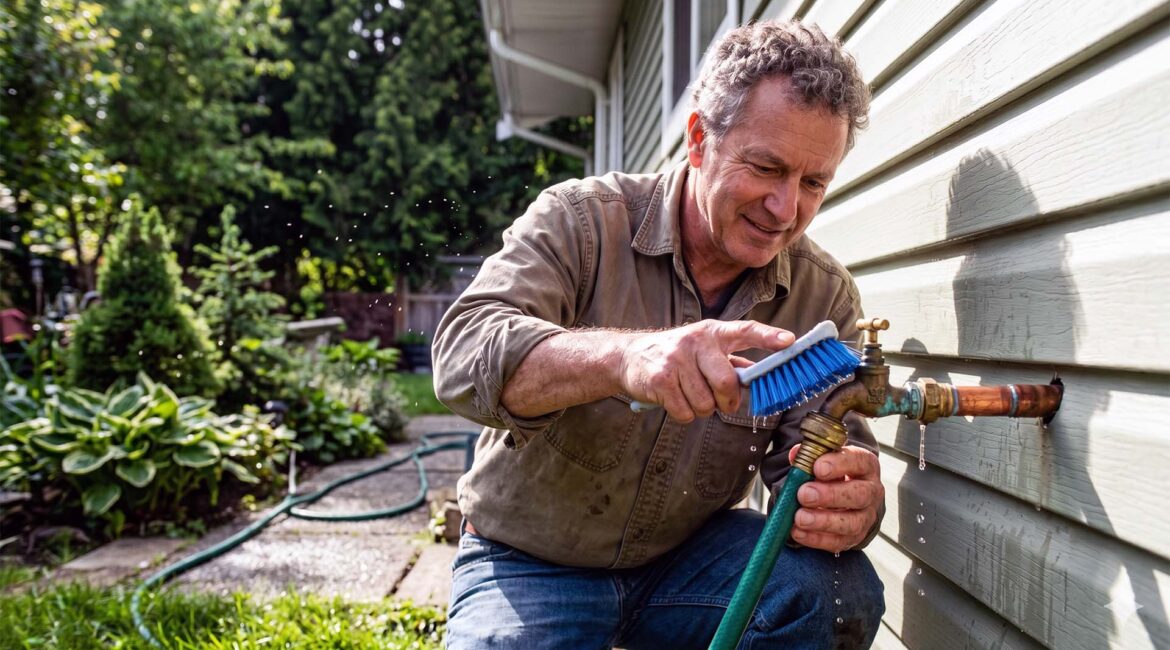
Disconnect any hose. Turn the outdoor tap on all the way. Then walk back inside and put a hand on the wall directly behind the spigot. If it’s an upstairs unit, check the ceiling below it too. Damp drywall, water staining, any active drip? The supply line cracked inside the wall.
A working outdoor faucet runs full pressure with no leaks anywhere on the line. Anything else needs attention right away. Water inside a wall does cosmetic damage in days, and it can compromise framing if it sits.
Skip it and: What starts as a simple valve swap turns into drywall, paint, and possibly mould remediation.
Fix 5: Descale Faucet Aerators Across the House
Aerator screens collect chlorine residue, sediment, and small particles from your supply lines over time. You’ll know they’re due when the flow at the kitchen tap slows down, the spray pattern goes sideways, or water starts splashing where it never used to.
Twenty minutes for the whole house:
- Unscrew each aerator by hand. If it won’t budge, wrap pliers in painter’s tape so they don’t scratch the chrome and try again
- Drop them in a cup of white vinegar
- Soak for an hour
- Rinse, reinstall hand-tight, then a quarter turn with the tape-wrapped pliers
If an aerator straight-up won’t unscrew, don’t force it. Stripped threads on a chrome faucet usually mean replacing the whole fixture, which is a much bigger job than a clogged screen.
Skip it and: Restricted flow makes you run the tap longer, crank shut-offs harder, and wear out faucet cartridges faster. Eventually, you’re replacing the whole fixture.
When to Call a Pro
Some signs mean the DIY window has closed. Don’t try to troubleshoot any of these on your own:
- Standing water under a water heater, or rusty water that won’t clear after half an hour of flushing
- Sump pump that won’t activate during the bucket test, or short-cycles over and over
- Wet drywall, ceiling staining, or any drip behind an outdoor spigot
- Shut-off valves that won’t fully close, or supply lines showing visible corrosion
- Reduced water pressure across the whole house, not just one fixture
May maintenance keep small problems small. Catch them now, and most are quick fixes. The same issue in July, after the damage has spread? That’s a much bigger job.
If you’ve spotted one of these and you’re not sure how bad it is, give us a call at (604) 897-4989 before it spreads.
Frequently Asked Questions
- When should I flush my water heater? Once a year for most homes. May is a strong default because you’re clearing winter sediment before summer demand piles on. Tankless units have their own descaling schedule, so check the manual.
- How often should I test my sump pump? Once in spring, once in fall, minimum. If your pit collects debris or you’re in a high-water-table area, test quarterly. Always test before any forecast with multi-day rain in it.
- How long do washing machine hoses really last? Maytag and most other manufacturers recommend swapping rubber hoses every 5 years. Braided stainless steel hoses go longer, but still give them a look once a year for kinks, rust at the connections, or stiffness.
- Do I need a permit for any of these fixes? Nope. All five are routine maintenance, and you don’t need a permit or a plumber to handle them. Permits come into play for new installations, pipe relocations, or water heater replacements.
Got a question we didn’t cover here? Call (604) 897-4989 and we’ll walk you through it.
The Bottom Line
May plumbing maintenance is the cheapest version of any of these repairs. The same problem in July involves more damage, more rooms, and more parts. Sediment, stuck floats, cracked hoses, split lines, they all show their warning signs in spring. Catch them now, fix them in under an hour each, and skip the emergency calls in summer.
If any of the May checks turned up something off, give us a call at (604) 897-4989.
Get Help When You Need It
If anything on this list looked off when you checked it, give us a shout. We serve South Surrey, White Rock, and Langley, and book around your schedule.
Call (604) 897-4989 or contact us here.